
It was a warm June day in Davenport, Iowa. Thomas Hennen ’00, then pastor of Sacred Heart Cathedral and vicar general of the Diocese of Davenport, was sitting in his office at the chancery. The phone on his desk trilled.
“I see this call come across from Washington, DC,” Hennen recalled. “And normally, I kind of ignore those calls that are from someplace I don’t know, but I do have people I know and friends in Washington, DC.”
He picked up the phone, and was greeted not by a friend, but by a man with a French accent, “Is this Fr. Thomas Hennen,” he recounted. “And I said, ‘yes.’ And then he asked, ‘Are you alone?’”
It was at 11:15 a.m. on Wednesday, June 25, 2025, that Cardinal Christophe Pierre informed Hennen that Pope Leo XIV had appointed him the next bishop of Baker, Oregon. Cardinal Pierre wasted no time, asking Hennen on that same call if he would accept this life-changing appointment. Hennen’s answer came swiftly.
“To my mind, there was no answer but yes.”
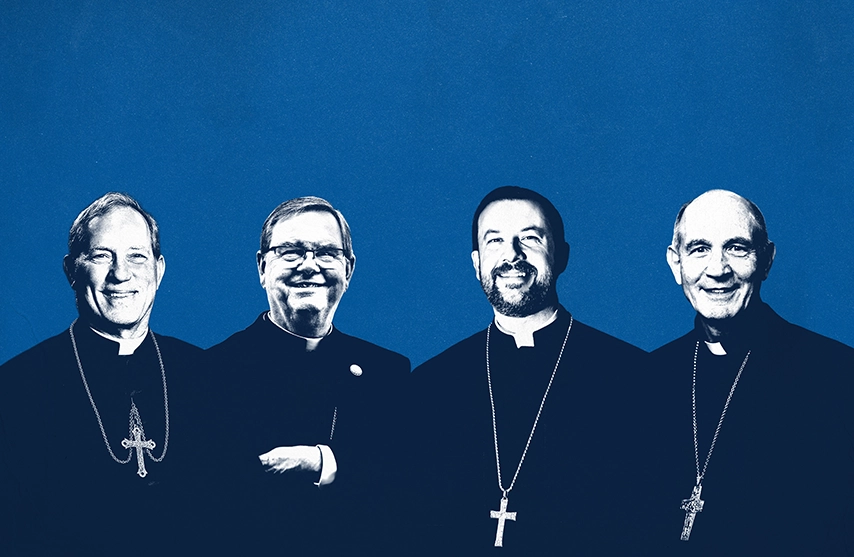
On Sept. 29, 2025, Hennen became the ninth St. Ambrose graduate to be consecrated a bishop in the Catholic Church. Four of those men are actively leading dioceses across the United States, guided by their foundational St. Ambrose education.
These men, like the five others before them, come from different backgrounds, and attended the school during different eras. But all have remained connected to the school and recall fondly how their time at St. Ambrose was the first step in their faithful leadership.
The Most Rev. Timothy L. Doherty ’72, Sixth Bishop of Lafayette, Indiana, 2010-present
The first time the Most Rev. Timothy Doherty ’72 visited St. Ambrose was move-in day in the fall of 1968.
“And that’s how my career started at St. Ambrose,” the Chicago-area native reminisced. It was a transformative time for the college. 1968 was the year that St. Ambrose officially became co-educational, and in 1970, classes were suspended to allow students to go home and protest after the invasion of Cambodia and the shooting deaths of four students at Kent State University by the Ohio National Guard.
“To go off to school, when cities were burning and politicians and race leaders were being assassinated – there was a tumult like nobody could believe. I was 17 when I got to St. Ambrose, but, when I turned 18, I had to register for the draft. Those were big turning points in young man's life, and St. Ambrose was the background for that.”
One moment that has stayed with him over the decades was a day when the local bishop held a meeting with some students. According to Bishop Doherty, it was a group of “30 angry guys in a classroom.” It was the height of the Vietnam War. The students wanted to discuss what the church was doing about the war and political turmoil.
“The bishop sat back on the desk – and he was speaking to the 30 of us in there – and somebody asked him a hard question, and he just looked at us and he said, ‘I don't know.’ It was the first time I ever heard a priest or a bishop say, ‘I don't know.’ It was like a hand grenade went off in the room. We were stunned. I think back on that in terms of forming my ministry.”
It was this moment and a bible class with Rev. Herman Strub ’30 that Bishop Doherty points to when he reflects on the formation of his ministry. “He drilled us on a lot of things,” Bishop Doherty said of Fr. Strub. “But at the end he said, ‘I want you to remember two words.’”
Those words were: heilsgeschichte – salvation history in German, and hesed – Hebrew, meaning mercy or the loving kindness of God. “Fr. Strub said hesed is a theme that is running through the Old Testament. This word has become really important in terms of how I pray and how I preach, and how we understand God is so much larger than what we understand is mercy and love.”
For Bishop Doherty, his liberal arts education has endured the test of time. A calligraphy class with Rev. Edward Caitch ’39 inspired his approach to teaching. He often kept in mind the “gentle, kind, and respectful” approach the priest took with each student “depending on their level of talent and intensity.”
Bishop Doherty also drew on his science and philosophy courses while serving with health associations and committees. For him, every day is a reminder of the profound impact of his Bachelor of Arts degree.
“The great thing about liberal arts education is there were pieces of political history, psychology, English, art, science – all of those things have come to play. It was such a broadening experience that it helped attach me to important things in the world – both materially, scientifically, and spiritually.”
Through the years, Bishop Doherty has remained connected to the school whether through visits to campus, lifelong friendships, or physical tokens which remind him of his time at the school. “In preparation for this interview, I’m wearing my St. Ambrose class ring today,” he laughed.
The Most Rev. James Mark Beckman ’84, Fourth Bishop of Knoxville, Tennessee, 2024-present
A priest in the Diocese of Nashville for more than 30 years, the Most Rev. James Mark Beckman ’84 envisioned retiring as a pastor. Then he got a phone call.
“It was a Monday morning,” he recalled. “I had just finished my morning prayer. I have to say, I was not prepared for that call at all.”
Then Fr. Beckman was told Pope Francis had named him the next bishop of Knoxville, Tennessee. His mind was scrambling, and he asked for time to think about it. Through prayer, he discerned peace in accepting this unexpected calling and became the third St. Ambrose graduate from the Diocese of Nashville to become a bishop.
Bishop Beckman's path to the university can be traced back to the early 1900s, when the Most Rev. William Adrian graduated from St. Ambrose College in 1907. A native of Sigourney, Iowa, Bishop Adrian served on the faculty at St. Ambrose for more than 24 years before being named the seventh bishop of the Diocese of Nashville in 1936. He began sending seminarians to St. Ambrose to study. One of those students was the Most Rev. James Niedergeses ’41 – ninth bishop of Nashville. He, in turn, continued sending seminarians to St. Ambrose, eventually leading the future bishop of the Diocese of Knoxville, Tennessee – Mark Beckman – to the school.
“I think my St. Ambrose education was very important in shaping my whole priesthood really,” Bishop Beckman reflected.
At the time, Bishop Beckman was one of 30 seminarians living in Hayes Hall. He described campus life, particularly the seminarian life on campus, as vibrant and close-knit.
“We had daily Mass at 4:30 p.m. in the chapel, and morning and evening prayer. There was a strong sense of community,” he said. “There were several priests that were great role models for me, and their theology, their teaching, their preaching, have really shaped a lot of my ministry as a priest and now as a bishop.”
His most impactful role model was Rev. Edmund “Ed” Dunn ’58. Fr. Dunn was rector of the seminary during that time. Bishop Beckman credits him with influencing his “Mass presiding style” – instilling a sense of community while maintaining the mystery and sanctity of the Eucharist – and his approach to preaching.
“One of the things that Fr. Dunn was passionate about was connecting the gospel to everyday life: How does this shape our human journey, and how does it address political and social and ethical questions of the day. So, in my own preaching, I do often ask the core question: What does the gospel say to people today about living our authentic Christian lives, and how does it address the great social and ethical questions of our day?”
Now, as a bishop, Beckman draws inspiration from his alma mater’s patron, Saint Ambrose of Milan, and often asks for intersession on his behalf.
“Saint Ambrose was incredibly gifted with preaching. But he was also an incredibly gifted administrator, shepherd, and leader, and so his example has been sort of an inspiration through the years.”
A visit to campus in 2023 showed him the enduring promise of a St. Ambrose education.
“I had the opportunity to kind of wander around campus, meet some of the students, and it gave me great delight to see the experience that I had back in the 1980s at St. Ambrose, in my mind, is still very alive and well. Students are engaging, personable, and really excited to be on campus.”
The Most Rev. Robert Gruss ’90, Eighth Bishop of Rapid City, South Dakota, 2011-2019, Seventh Bishop of Saginaw, Michigan, 2019-present
The old guy living in the dorm. That’s how the Most Rev. Robert Gruss ’90 begins his recollection of his time at St. Ambrose. A 33-year-old living amongst 18-year-olds, he felt almost old enough to be their father. But it was a good time, he reflects.
“And when the Lord calls you to something different, it gives you all the graces you need to kind of get through it.”
The Lord had been calling for a while, but Bishop Gruss had no interest in becoming a priest. During his freshman year at Madison Area Technical College in Madison, Wisconsin, “the whole notion of the priesthood came to my level of consciousness,” he said. “I basically dismissed it.”
Gruss wanted to get married and have a family. He earned his associate degree in civil engineering and went to work in a factory making axles for four-wheel drive trucks. He decided he didn’t want to spend his life in a factory. Flight school was his next endeavor.
“I had a flying experience when I was young, like eighth grade. And so, I thought maybe I could make a living flying an airplane.”
He finished flight training and became a certified pilot. Then, he moved to Iowa for an aviation job.
“Over the course of a year, I began a search for God,” he said. “I had kind of gotten away from the practice of my faith, became a very lazy Catholic, was kind of in the party scene and things like that. But I found myself not very happy regarding life in general.”
Bishop Gruss didn’t have “some big conversion.” He describes his late-20s as a rediscovery period. In his search for God, he began to attend Mass again and actively participate in parish life. It was during this time, 13 years after the priesthood first crossed his mind, that the idea returned.
"Once I became all-in living my faith, I went all-in for the Lord. That's when the whole idea of the priesthood came back. And I thought, ‘wow.’ I thought, ‘I really should not just, pass this off like I did before.’”
He entered seminary at St. Ambrose in January 1989. Finally ready to answer God’s call.
Though his time at SAU was brief, Bishop Gruss credits his St. Ambrose education for solidifying his call to the priesthood, helping him to focus his heart and mind on the Lord and where God was leading him.
“St. Ambrose was just the beginning,” he said. “I think the priests and faculty were very instrumental in helping me discern my vocation. People like Rev. William “Digger” Dawson ’50 and Rev. George McDaniel ’66, (Hon. ’21) and Fr. Dunn – being around priests, seeing how they live their life and what they’ve been called to do really helps in the discerning part.”
The university also helped him experience what it truly means to serve others, something he sees as inherently valuable for priestly formation.
“St. Ambrose is where you begin to learn about what it means to really serve the Lord and serve the church, everybody in their own way. Whether you're a lay person or you're somebody pursuing the vocation to the priesthood, we're all called to service. It's by the nature of our baptism. And that’s part of the St. Ambrose identity – being of service to the world and to the communities.”
He returned that service to the university as a member of the Board of Trustees from 2013-2020, helping to guide the university from his perspective as an alum and as a bishop.
The Most Rev. Thomas Hennen ’00, Seventh Bishop of Baker, Oregon, 2025-present
The installation of the seventh bishop of Baker, Oregon, was a St. Ambrose reunion of sorts. Former students, classmates, and colleagues of the Most Rev. Thomas Hennen ’00 crowded into the pews of St. Francis of Assisi Church in Bend, Oregon, to celebrate this exciting new chapter for a fellow Ambrosian.
“It was beautiful,” Bishop Hennen said of the St. Ambrose attendees. “The university was very well represented both in terms of alumni and current faculty and administration.”
It’s no surprise so many Ambrosians made the trip to Baker. Bishop Hennen’s time at SAU spans two eras: 1996–2000 as a student, and 2017–2021 as chaplain and director of Campus Ministry.
As a student, Bishop Hennen immersed himself in all the university had to offer. He was a resident advisor (RA), took part in student government, was cast in theatre productions, and was actively involved in Campus Ministry and service projects. These experiences fueled his faith and prepared him to become an empathetic leader.
“I think we like to pride ourselves, and should, on our formation of the whole person,” Bishop Hennen reflected. “I never felt like I was just there to learn, or to get these credits, or to get pushed through. I was there to grow completely as a human being and to become the servant that God is calling me to be.”
When he entered St. Ambrose, Bishop Hennen wasn’t positive he was called to the priesthood. In his mind, joining the seminary at SAU was the practical way to discern this calling.
“My attitude going into St. Ambrose as a seminarian was, ‘I’m going to give this a shot.’ It wasn’t, ‘I’m going to be a priest.’”
As he engaged in the discernment process during his first year in seminary, Bishop Hennen thought God might be calling him to something else. “Part of that had to do with just human relationships. I met a lot of friends. I met a girl at the end of my freshman year.”
He removed himself from seminary during his sophomore year. But the priesthood persisted in his mind. He broke up with his girlfriend after a year, thinking he needed to be in a neutral space – not in the seminary, not in a relationship. But then the story repeated itself.
“I met another girl. And I thought, ‘Well, okay, maybe this is what God had in mind.’ But it was like the priesthood would not let go. When God’s knocking at the door, he doesn't stop knocking, usually.”
Bishop Hennen rejoined the seminary his senior year of college, and he never looked back.
“I found one affirmation after another that I was on the right track,” Bishop Hennen said. “There was great joy, great happiness, and a sense of peace.”
Now, 21 years later, he carries his St. Ambrose education and the university’s patron saint into his new role as a bishop.
“I put the bees on my episcopal crest for a reason, not only because of St. Ambrose University, but because of Saint Ambrose of Milan. I like that image of the bee as an example of quiet diligence and evangelization, kind of pollinating the faith. And just a good reminder to me of Ambrose, both the university and the man.”
And he credits the university with helping him to become the leader he is today.
“St. Ambrose gave me a safe place to fail,” Bishop Hennen said. “The opportunities for leadership where you can go out on a limb and try something but not be afraid because you’re surrounded by faculty and staff that are going to support you and walk with you – I so appreciated that.”
Bishop Hennen continues to stay connected to the university as a member of the Board of Trustees, and most recently visited campus in October 2025 for Homecoming weekend, celebrating 25 years since his St. Ambrose graduation.
“Those values we’ve emblazoned now – courage, wisdom, justice, service – I feel like those words really do capture well what Ambrose helped me to do.”
What makes a bishop?
It seems extraordinary that nine men, four in the last 15 years, all from a small college in Davenport, Iowa, would become leaders in the Catholic Church. Each living bishop has their own interpretation of what could be at play.
“I don’t think it’s a fluke,” Bishop Hennen contemplated why so many men from St. Ambrose have become bishops. “But it’s hard to say how the spirit moves.”
“It’s anyone’s guess,” Bishop Doherty said. But he speculates it’s something about Midwest culture.
“When I was newly ordained, Vatican diplomatic services were going after priests from the Midwest,” Bishop Doherty recalled. “They found that these guys had the right balance of self-assurance, but they weren't egotistical or loud or climbers. I know that sounds really funny, but, you know, the last guy you want as a bishop is the guy who really wants to be a bishop, because it is really, really different when you get into this chair.”
Bishop Beckman believes there is something about the foundational education seminarians received at St. Ambrose.
“I suspect that what the church has been looking for in bishops in recent years are people who are both pastoral but also well-grounded in theology,” Bishop Beckman said. “I think St. Ambrose did a really good job of preparing us for both of those things.”
But for Bishop Gruss the answer is simple: It’s the will of God.
“I know a lot of bishops. Everyone comes from a different background, from a different path. People don't go to St. Ambrose to become bishops. It's something that's somehow in the Lord's plan.”
Whatever it is, St. Ambrose is proud to have educated nine leaders of the Catholic Church in the United States, living and deceased. It’s a testament to the enduring promise of a St. Ambrose education – to form the next generation of compassionate, ethical leaders.
Deceased bishops of St. Ambrose
The Most Rev. William Adrian 1907, Seventh Bishop of Nashville
The Most Rev. Maurice Dingman ’36, Fifth Bishop of Des Moines
The Most Rev. James Niedergese ’41, Ninth Bishop of Nashville
The Most Rev. Lawrence Soens ’46, Fifth Bishop of Sioux City
The Most Rev. David Choby ’69, Eleventh Bishop of Nashville