
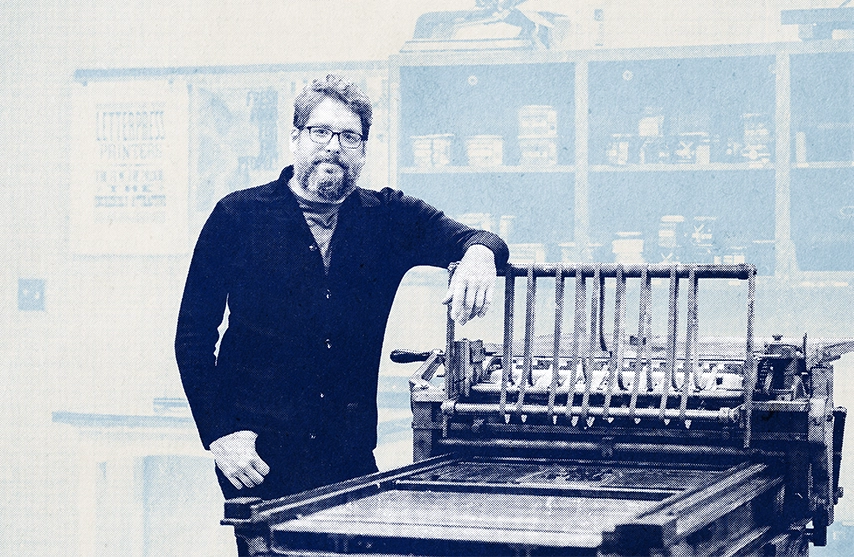
When Joseph Lappie, MFA, describes his work with the Peace Paper Project, he always returns to one simple word: breath. For the refugees, survivors of violence, and marginalized communities he works with, the simple act of making paper and books becomes a way for them to breathe again – a brief pause from survival, to create something with love out of strife.
Lappie, professor and chair of the art + design department at St. Ambrose University, teaches classes on book arts, printmaking, and drawing. He also serves as the current co-chair of the Faculty Assembly. Beyond the classroom, his artistic and scholarly work demonstrates how the humanities can be used as tools of healing, survival, memory, and community building. at vision is taking him abroad, as he collaborates with the Peace Paper Project based in Hamburg, Germany, leading workshops with Ukrainian refugees.
From Combat Paper to Peace Paper
The Peace Paper Project grew out of an earlier initiative called Combat Paper, co-founded by Lappie’s graduate school peer Drew Matott, MFA. That project focused on veterans returning home, many struggling with PTSD. Veterans cut up their uniforms, pulped them, and turned the material into paper on which they printed and painted, reclaiming trauma through transformation.
“In the early 2010s, Combat Paper decided to focus exclusively on having veterans lead the workshops and provide services,” Lappie explained. “Since Drew Matott is not a veteran, he sold his share and released the title, going on to form the Peace Paper Project. They began working around the world – with widows, orphans, marginalized communities, and city centers – making paper for healing, art as therapy, and building small paper shops.”
In Hamburg, where Matott has lived for a decade, Peace Paper continues to expand. He now leads the project alongside Jana Schumacher, a native German artist and the current co-director of the Peace Paper Project. They now travel nine months each year, working with nonprofits, city councils, and government partners worldwide.
Lappie has participated as a host and collaborator, helping bring initiatives like “Panty Pulping” – transforming clothing associated with trauma into new paper objects – to U.S. campuses and communities. He is also committed to connecting the project’s global mission back home to the Quad Cities.
Healing through making
For Lappie, the process of making paper is both literal and symbolic.
“It’s a very tactile process,” he said. “You’re literally beating something to a pulp, destroying it, and then building something new out of it. You’re taking something difficult and making it better.”
His recent work in Estonia reflects that philosophy. Last year, he joined Peace Paper at the Art of Survival conference in Tartu, collaborating with Ukrainian refugees to create handmade journals.
“Some of them are artists, some aren’t,” he said. “It wasn’t about overthinking what the art had to be – it was about the making being a big part of it. We used the Ukrainian colors for the paper, handmade covers, and had three or four different binds. It was memory work, healing work.”
The project will continue in Tartu and Tallinn, where Peace Paper partners with the city council to engage Ukrainian refugees. Plans are also underway for workshops in Narva, on the Russian border, working with both Russian-speaking Estonians and displaced Ukrainians. There are also tentative plans to bring the project to the United Arab Emirates in 2027, where Peace Paper hopes to work with Palestinian refugees.
The logistics of hosting these events can prove to be challenging.
“It’s hard to bring a Hollander beater across borders. It’s hard to bring sewing needles, sharp things,” Lappie said. Still, the mission persists: to give communities space for expression, even if fleeting.
“A drop of release”
Lappie resists overstating the outcomes of the Peace Paper Project. The goal is to allow space for those who need it to process their emotions in a safe environment.
“Rarely does it change a life,” he said. “But it allows for a moment. A drop, a single drop of release from horror.”
That small release can ripple outward. Workshops gather individuals into communities of production and creation.
“Being in a community of making is always going to help,” Lappie said. “If we don’t have belief and hope in the objects we make, how they are seen, what they mean, and the thoughts about them, then we are in a particularly sad spot.”
He hopes to extend this work locally by partnering with Quad Cities organizations assisting refugees, such as United Way and Tapestry Farms, a nonprofit urban farm supporting refugees resettling in the community.
“Creating an environment of making is just as important here as it is abroad,” he said. “It’s about the heart, the mind, and the community – but also about providing skills that can help people thrive.”
Art as responsibility
Lappie’s work with the Peace Paper Project embodies the values of servant leadership at the heart of St. Ambrose University. For Lappie, the project aligns with his larger belief in the power of paper, print, and book arts as engines of justice and equity.
“Book, paper, and print are the progenitor of social justice in art,” he said. “Before that, painting, sculpture, and architecture were for the rich or the church. But when paper, print, and books came around, you could disseminate information. You could publish a Bible, and people could read it themselves.”
That history informs how he teaches at St. Ambrose.
“There’s very little truth to the singular genius. It takes a village,” he said. “As an artist and educator, it’s not about my personal artwork ending up in museums. It’s better to help people make things that have meaning for them. To see someone say, ‘I didn’t know I could do that – and now I can’ – that’s way better than any museum.”
Companionship and perspective
Lappie’s most vivid memories come from Estonia – his first time in the country.
“It felt surprisingly similar to the Midwest,” he recalled. “Flat, agrarian, familiar. But the best part was companionship. To sit at the end of the day, share a meal, process together – that's the joy.”
That companionship strengthens his resolve to pursue art as kindness and healing in the second half of his career. Backed by support from grants, he continues to bridge his personal practice, his teaching at St. Ambrose, and the Peace Paper Project’s mission.
“Art’s not magic,” he said. “Creation isn’t magic. We’re not special people, we learn how to do things, hard things. It’s not dissimilar from athletics or understanding math. Everyone can learn. Everyone can make. Everyone can contribute. My responsibility is to take all the goodness I have through making and, to the best of my ability, present and provide it to other people.”
Ultimately, the Peace Paper Project is about giving people a pause – a space to transform pain into something tangible and hopeful.
“It’s about the breath,” Lappie said. “Just having that moment to recontextualize.”