

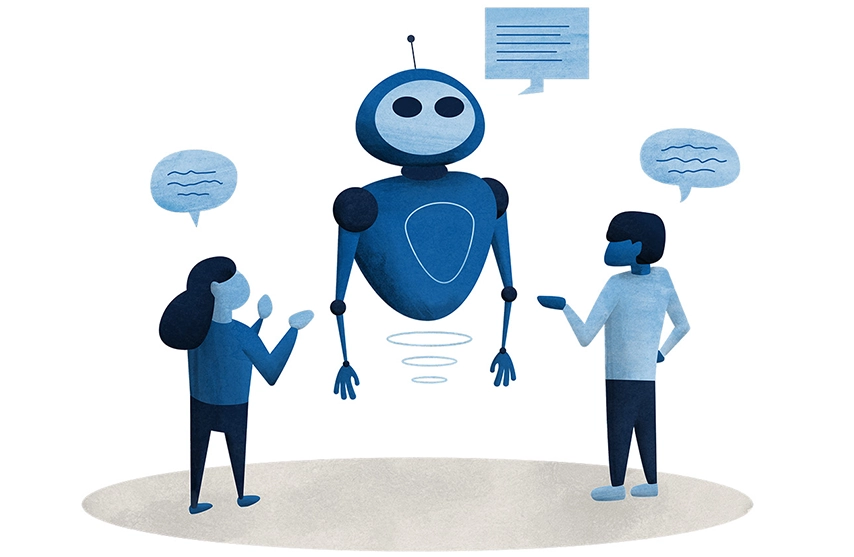
Ambrosians are unafraid to ask big questions, to embrace change, and to explore the possibilities all around us. We don’t shy away from emerging technology. Instead, we welcome it. We question its ethics, discover how it can be used for the greater good, and think critically about the implications it will have on ourselves and the world around us.
Tanya Randle, PhD, associate professor of philosophy at St. Ambrose, has been teaching and researching artificial intelligence since 2016. Her background in the philosophy of ethics has been imperative as the university explores its approach to integrating AI in the classroom.
Randle and others co-facilitate the university’s AI Institute, a faculty learning community which serves as a collaborative space for instructors across disciplines to explore how Boodlebox – a secure, multi-model AI platform piloted this fall by SAU faculty – can enhance teaching and learning. Faculty use the Institute to exchange ideas, test classroom projects, and discuss the ethical implications of AI before introducing it to students.
“We started the whole institute not talking about AI, but with the purpose of education,” Randle said. “Then we asked how AI can contribute to that purpose, or where it might challenge it.”
Through these discussions, Randle’s group workshops nuanced case studies and drafts “guidelines or guardrails” for ethical use. “Anything that would leave the human out of the picture would be unethical use of AI,” she said. “Any use of AI that bypasses critical thinking circumvents the purpose of why we are all here doing this thing.”
A secure space for learning with AI
Boodlebox is designed for education and compliance needs, giving students and faculty a way to work with multiple AI models in one secure stream while preserving privacy and classroom context.
Early faculty-led projects span disciplines and assignment types. In information literacy, faculty are using Boodlebox to plan and produce student podcasts while pressure-testing facts and sources. Marketing and kinesiology courses are using Boodlebox across the semester to plan campaigns and events with documented decision trails. Writing-intensive courses employ it for grammar and APA self-checks before submission.
In Randle’s classroom, she’s introduced “Socrates 2025” – a course bot, or conversational tool programmed with course-specific prompts and guidelines, that engages students in a philosophical dialogue. Rather than submitting a static journal entry, students hold a conversation with the bot, which poses follow-up questions and challenges their reasoning before they submit the exchange for grading.
“I care about process over product because we’re learning. I want to see how students got there.”
Randle says the dialogue format encourages students to slow down, reflect, and show their thinking. “It’s a way to make the invisible work of reasoning visible,” Randle said.
She also provides an alternative for students with ethical objections to AI.
“If it’s integrated into the classroom, there is an alternative option for students that have legitimate objections.”
In health sciences, the physical therapy program is experimenting with ways to make classroom AI use interactive and reflective. A team built a diagnostic bot that walks students through a simulated patient exam.
“We created a bot where a student goes through and answers questions they would encounter during a diagnostic exam,” said Samantha Dunn, EdD, director of learning, St. Ambrose. “We incorporated a virtual clinical instructor that steps in whenever the student goes in a direction that doesn’t make sense.”
Dunn says the goal is to help students practice professional reasoning and receive feedback earlier in the learning process. It also allows exploration and mistakes in a low-stakes environment. The diagnostic bot lets students see where they went off track and why – a process she said leads to "real learning."
Learning the technology
As the university carefully examines the use of AI in various academic settings, many are exploring the technology in new ways and learning its capabilities. The training for this technology looks different across fields.
“Prompting – the basic running of a tool is easy,” Dunn said. “The question of when to use the tool is going to be more nuanced.” Her team meets one-on-one with AI Institute participants and convenes cross-disciplinary share-outs that “ignite new ideas.”
The university has roughly 300 active Boodlebox users and counting, Dunn says, and remains in an intentional build phase.
“Taking the time to do this right is my vision for the next couple of years,” she said.
Keeping the human at the center
Randle agrees the current stage is “early exploratory.” What won’t change, she says, is the focus on human capacities.
“I hope that students gain a better understanding of AI’s limits, of its shortfalls, particularly when it comes to those very important human things,” Randle said. “Once you recognize the difference between an AI and a human, then that opens up a better possibility for having appropriate, collaborative uses of it.”
Dunn is optimistic for the future and believes St. Ambrose is addressing the sensitivities of artificial intelligence with care and responsibility.
“When we use AI correctly, it’s going to give us opportunities to have deeper conversations on the human level,” Dunn said.