

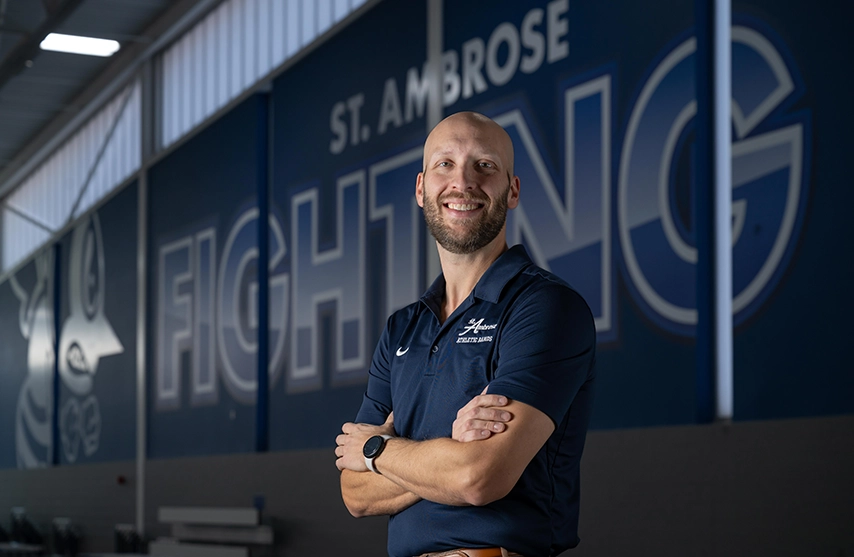
When you think of football, you probably imagine the roar of the crowd, the crash of a tackle, or the piercing interruption of a referee’s whistle. But for St. Ambrose University’s new director of the Fighting Bee Marching Band, the best sounds on game day come when the field becomes their stage, and the music begins.
With more than a decade leading marching bands across the U.S. and internationally, Matthew Winarski, DMA, brings his passion for music, leadership, and community to the gridiron at St. Ambrose. Here, he is building a culture of respect while helping students embrace challenges and celebrate success. His approach centers on one powerful idea: when a band becomes a family, great music — and great growth — follow.
What excites you most about joining St. Ambrose and directing the Fighting Bee Marching Band?
The most exciting thing, and what first attracted me, even during my interview, was how recently the band program was created and how much energy surrounds it. That excitement comes not only from the students and staff but also from athletics, the university, and the community. You usually only see that kind of enthusiasm in long-established programs. I moved here from Columbus, Ohio, where the Ohio State Marching Band has a century-long tradition. To see a similar level of energy for a ten-year-old band is incredible. Everyone in town knows the Fighting Bee Band, and being part of that growth is really fun.
What is your vision for the program, and how do you hope it will grow in the coming years?
One of the most important things for me with any band program is getting outside our bubble – and I don’t just mean leaving the St. Ambrose Dome – I mean stepping beyond our comfort zone as a university. It’s important that we’re seen by the community and by high school students locally, regionally, and eventually nationally. We need to show off the amazing work our students are doing. At the Rock Island Showcase, we performed for several nearby high school bands, and it was phenomenal. I want more of those opportunities where students can share their hard work, their energy, and what St. Ambrose is all about. They put on a great show, carried themselves professionally, and then went out to talk with high school students. Seeing them connect, celebrate each other, and share that excitement, that’s what it’s all about. I want to create more of those moments.
Building a band is about more than just music. At St. Ambrose, we strive to create a supportive, welcoming community where all students feel they belong. How are you building that culture and community in the marching band?
At North Dakota State, we created a program called Community of Respect. It’s where we decide, as a band, what’s important to us, our pillars, our foundation, and how we want to operate throughout the season. It guides how we handle conflict, celebrate success, and learn from mistakes. That’s the culture we’re building here, too – one where every voice in the band matters, and we understand what’s important to everyone.
Students have shared that they want to feel respected by leadership and treated as equals. Respect should be consistent whether you’re a first-year piccolo player or a senior drum major. Our student leaders have really embraced this concept and made it their own. That commitment to respect, to doing more than what’s asked, is what defines our culture now and makes the difference.
Every activity St. Ambrose students participate in prepares them to be future leaders. What skills will students take away from their marching band experience that will shape them to lead courageously, seek truth and justice, and work for the common good?
I feel most at home with the smaller private liberal arts colleges. At St. Ambrose, what we do so well here is the opportunities we provide to students. We live by this concept of ‘Yes, and.’ Yes, I can be in marching band, and I can be on the wrestling team. We're allowing our students to explore all these really amazing things and really create very unique and intricate versions of themselves, and explore things that are important to them. I think that's what makes us so special, is that we really lean into that. We help our students to understand that they can do a lot of things, teach them how to balance that, and how to do these things well.
How do you encourage your students to embrace challenges, whether that’s on the field, in rehearsal, or as leaders within the band?
Early in the season, we talked a lot about challenges as we finished our show. Having four weeks between football games was tough. It’s hard to keep improving without regular performances to show what we’ve accomplished. I took that opportunity to speak with the students about the difference between a good band and a great band: it’s how we handle mistakes. Instead of thinking, ‘I messed up,’ we ask, ‘Why did that happen, and how can I change it?’ When we remove the idea of mistakes being bad, it opens the door for growth. Those weeks pushed us to focus on perspective and the big picture. It’s easy to zero in on individual missteps, but stepping back helps us see how everything fits together.