

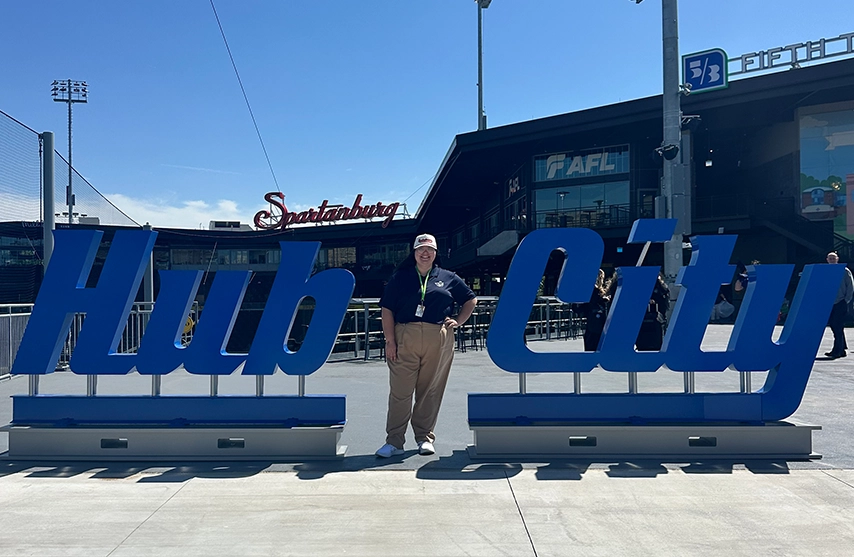
Bailey Conner ’21 became who she was meant to be by being open to any number of unanticipated opportunities, both after enrolling at St. Ambrose University in 2017 and after graduating with a BA in Sport Management in 2021.
A passion for athletics? That was sparked while working as a student trainer for the Fighting Bees football team.
An interest in the degree program not previously on her radar? Conner discovered it through a mentoring relationship with a faculty member who kept an open door.
Experience working in minor league professional baseball, particularly in ticket sales and client-relationship building? A summer job, a related internship, and sales skills discovered through a class in SAU's business sales program all left her primed to succeed in her first post-collegiate job.
This April, Conner began her second season as ticket operations manager for the Hub City Spartanburgers, a Class A minor league baseball affiliate of the Texas Rangers.
Conner found her passion along a path of unanticipated self-discovery and full preparation that began with her decision to enroll at SAU.
“Sports management has really opened a lot of different horizons that I probably would have never considered,” Conner said.
It’s not the big leagues. It’s better.
Conner’s first job out of a SAU was with the Tulsa Drillers, a Texas League Double-A affiliate of the Los Angeles Dodgers. Two years later, she joined the Spartanburgers in Spartanburg, South Carolina, a brand-new Class A franchise that offered an opportunity to elevate from assistant ticketing manager in Tulsa to leading her own ticketing operation.
Conner found her way into ticketing through summer work with the Quad Cities River Bandits, which the SAU sport management program helped her land. An internship with the Chicago Bandits, a professional softball team in Chicago, followed. Along her path, Conner has discovered the all-hands-on-deck needs of “small ball” minor-league sports suits her well.
“My goal was to end up in Major League Baseball, but I think my heart really is in Minor League Baseball,” she said. “The craziness, the hectic schedule, just the ability to kind of have the fun that you want without the tighter leash MLB has.”
While sales and ticketing are her chief responsibility, Conner also participates in building marketing strategies for the Spartanburgers, whose name is based on what residents of the small community in the foothills of the Blue Ridge Mountains long have called themselves. The Hub City team has also created a whimsical marketing strategy around the burger tag, tying into the tourist community’s historic connection to casual dining, food plants, and restaurants.
“It is so much fun here,” she said. “It's traditional baseball, but also non-traditional at the same time. And so it's just so much fun with all the different alternate identities we're able to create — like Chip the Pickle — and different specialty theme nights and everything. So yeah, it's a whole lot of fun. I'm happy staying in Minor League Baseball.”
Calling on SAU’s lessons
Conner sure didn’t see professional baseball as her future career path when she left Streator (IL) High School seven years ago. She gave up participating in athletics after grade school, in part because girls’ sports were far less celebrated than those played by boys.
Funny, then, how an early opportunity to work on the Fighting Bees football sideline changed her life’s direction. She was a kinesiology major tracking toward a Doctor of Occupational Therapy degree when she enrolled. She was already questioning that path when she became a football student trainer.
“I really loved being on the sideline during the football games and just being able to form those relationships with the players, the coaches, and different staff as well,” she said. “So I knew that I definitely wanted to stay in the action and not take myself away from it.”
Conner had already formed a mentoring relationship with Sarah Eikleberry, PhD, assistant co-chair of the kinesiology department and director of the sport management program.
“Shout out to Dr. E,” Conner said. “She was definitely one of the best people for me to meet at St. Ambrose. She really helped me navigate challenges in college.”
Sports management options abound
Eikleberry helped Conner weigh her options and identify a sport management degree as the best way to stay in the game.
“Our graduates work in a variety of roles,” Eikleberry said. “Some work in more community-based organizations like park districts, YMCAs, and youth sports and recreation. And then we have our students who go into coaching or facility management, or a combination of those three, as well as the students that are able to penetrate the semi-professional and professional sports industry. And then we also have a new crop of students who are more interested in health. So, they're looking to pursue certificates and post-baccalaureate experiences in nutrition and health promotion.”
Working in professional sports, and particularly with a newly started franchise, Conner routinely leans into lessons learned in the SAU program. A class project where she assessed risk management has been helpful in ensuring that the new Hub City Fifth Third Ballpark is compliant with the Americans with Disabilities Act, and in anticipating potential ballpark liability issues. She didn’t anticipate her coursework in the sales program would suit her career path, but it very much has.
“I emailed Tom Hosmanek from the sales department, and I was like, ‘Oh, my gosh, I never realized how much I'd actually utilize your class. Thank you so much for all your coaching and teaching,’” Conner recalled. “The sport management program really developed a lot of those different skills I have needed.”
Paying lessons forward
Conner recently found another way to be open to opportunity when she signed up for the inaugural Women in Baseball Leaders Inspiring Future Talent Mentorship Program.
She had intended to sign up as a mentee and instead found she’d been assigned to mentor two young women starting their careers in the pro game. Conner discovered she is more than up to the task.
“Everything happens for a reason,” Conner said, noting she calls on lessons she learned from mentor Eikleberry in that role. “This is my fifth year in minor league baseball, and I've seen and done a lot of different things. It’s really nice to be able to share these experiences and then learn from these women as well.”
Eikleberry noted Conner is one of an increasing number of women who are SAU sport management alumni. Those graduates, she says, are leading incremental change on the gender front and paying their own opportunities forward.
“It's growing steadily,” she said of opportunities for women in professional sports management. “I have seen more of the women who are currently working in the industry really opening the doors wider for the young women who are coming into our programs. They see the onus on them not just to keep that door open, but to open it ever wider.”