
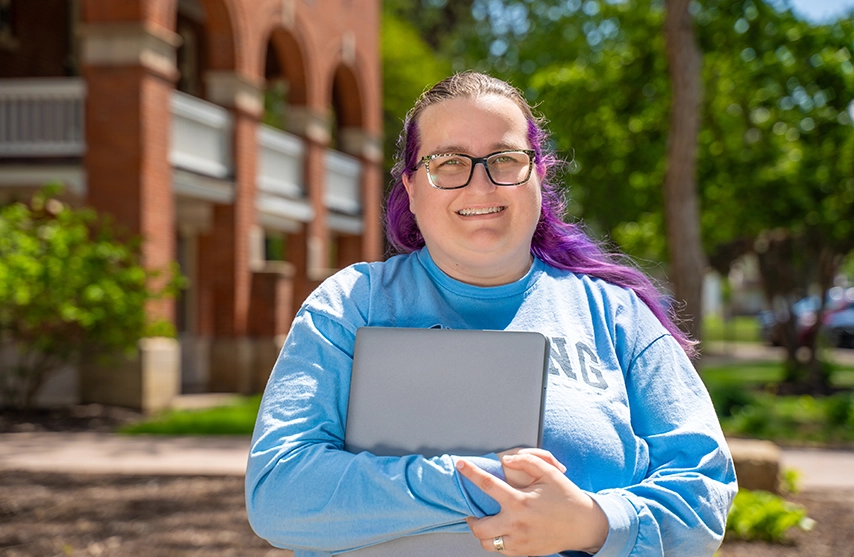
For seven years, Jennifer Parsons ‘26 stood at the front of a middle school classroom, teaching English and helping students work through reading assignments and class discussions. Now, she’s stepping into a new caregiver role – still working with children, but now as a pediatric nurse.
But during the COVID-19 pandemic, she started feeling pulled in a different direction.
“Nursing is actually my second career, so I was a teacher before I became a nurse,” Parsons said. “And then when COVID hit, I had a calling to go into health care.”
The transition didn’t happen overnight. While still teaching full-time, Parsons enrolled in a part-time LPN program, spending her days in the classroom before working through nursing school afterwards.
“I taught all day, and then I went to school for myself at night,” she said.
Even after entering health care, she knew she wanted to keep going. Nursing gave her a new way to care for and advocate for people, but she wanted more opportunities to grow in the field.
“I knew I wanted to do more than the scope of practice that LPNs are allowed to do,” she said.
That drive eventually led her to St. Ambrose University’s Nano Nagle Online School of Nursing, where she became the first student to fully enroll and graduate as a St. Ambrose student after the university took over the program.
Switching careers through a flexible program
Returning to school wasn’t just about earning another degree. Parsons had to find a way to pursue her goals while continuing to support her family and maintain a full-time job.
“I really don’t have the ability to go to school full-time in person just because I work,” she said. “I have a family. We need my salary to be able to live and function.”
When she discovered the Nano Nagle Online program was transitioning to St. Ambrose, the setup immediately felt like the right fit.
“I saw that it was going to be at St. Ambrose, and I was here in the Quad Cities, and I was like, ‘Perfect, this will work out great,’” she said.
The online format gave her the flexibility to keep working while completing her coursework wherever she could fit it in. This meant working at home, working at her local library, and bringing her laptop to any spot with a signal.
“I’ve even done some of my classwork while sitting in the dance studio lobby waiting for my kids to be done with their classes,” she said.
Even during the busiest weeks, Parsons stayed focused on the bigger picture – not just for herself, but for her family too.
“I knew what the end goal was,” she said. “I knew that it was going to be a really good model for my girls to show that if they want to do something, they can stick with it.”
Helping shape a new online BSN
As part of the first cohort moving through the Nano Nagle program fully under St. Ambrose, Parsons had a rare opportunity to help shape the online nursing experience for future students.
Because the program was still evolving, students were encouraged to give feedback about what worked well online and what needed to change. For Parsons, that process felt especially meaningful because she had experienced firsthand how difficult virtual learning could be while teaching middle school during the COVID-19 pandemic.
Some of that feedback focused on adapting traditional classroom methods for an online environment and finding technology that made coursework more accessible and user-friendly for working adults.
“I feel like I get a unique perspective because I can be like, ‘Hey, there’s this cool thing that we have available online that works a little better,’” she said.
She appreciated that the program didn’t simply try to recreate a traditional classroom online. Instead, faculty worked alongside students to figure out what translated well into a virtual environment and what needed a different approach.
“Online nursing programs are relatively new in themselves because it’s hard to think about learning nursing online,” she said. “But there are so many ways we can do things with technology.”
Even though much of the coursework happened remotely, Parsons quickly found a sense of community within her small cohort. What started as a group of classmates gradually turned into a support system.
“Our group chats on our phones are blowing up all the time,” Parsons laughed.
During clinical weekends, students often stayed together in hotels or Airbnbs, spending evenings studying, talking, and supporting one another through the demands of the program.
“It’s been a lot less lonely than I thought it was going to be online,” she said.
Online learning, in-person clinicals
Even though much of the coursework happened online, Parsons said the clinical experiences are what truly brought everything together. Through placements across Iowa, Minnesota, and South Dakota, she was able to experience different hospital systems and styles of patient care.
“It’s been nice to see how different places are run and to see what works well,” she said.
One experience in particular stayed with her. During a mental health clinical in Sioux Falls, South Dakota, Parsons worked with children in a behavioral health unit – an experience that unexpectedly confirmed her passion for pediatrics.
“I got to spend a lot of time with the younger ones, like 5- to 6-year-olds, coloring and playing games,” she said.
While it may not have looked like a traditional nursing experience from the outside, Parsons said those interactions taught her some of the most important parts of patient care.
“It’s the soft skills, right? Getting to talk to people and relating to your patients is important,” Parsons said.
By the end of the rotation, she knew she wanted to continue working with children.
“The children’s unit was kind of what sealed the deal with loving pediatrics,” she said.
ICU nursing
After graduation, Parsons will begin working in the neonatal intensive care unit at University of Iowa Health Care. This is a role that combines her love of pediatrics with the fast-paced environment she enjoys most.
“I’m just really excited to get to work with little babies all day,” she said.
For Parsons, though, nursing has always been about more than procedures or technical skills. What matters most to her is the relationship she builds with patients and families during some of the hardest moments of their lives.
“I want to be the kind of nurse that people remember,” she said.
Working in the NICU means those relationships may last days, weeks, or even months, and she hopes families leave feeling supported and cared for long after they leave the hospital.
“I want to be very caring,” she said, “and really looking out and advocating for them.”
As the first graduate to complete the Nano Nagle Online Nursing program entirely through St. Ambrose, Parsons has already helped shape the future of the program for students who come after her. But for her, the accomplishment is about more than being first. It’s about proving that even in the busiest seasons of life, it’s still possible to build something new for yourself and for your family.
Ready to earn your BSN? Study at your own pace through our NanoNagle Online School of Nursing and complete clinicals at SAU’s partner health centers. Learn all about our online LPN to BSN.