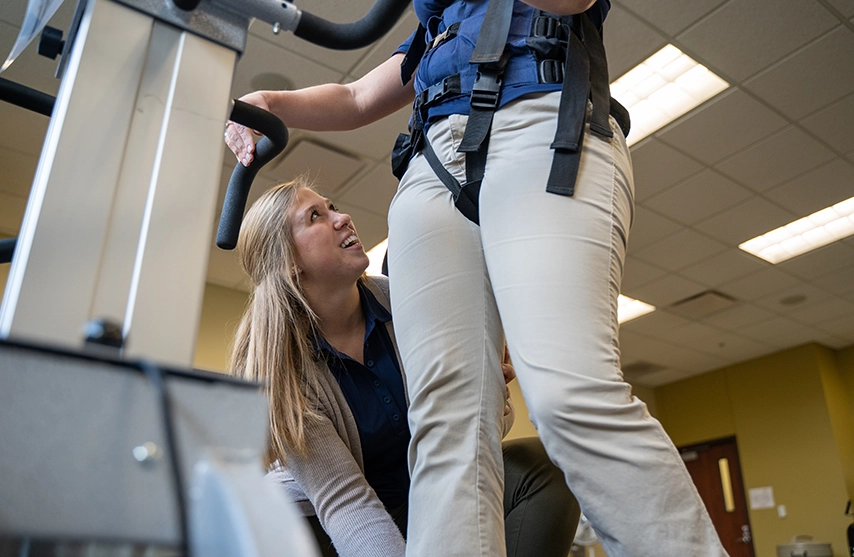
Implementing High Intensity Gait Training Across the Continuum of Neurologic Rehabilitation to Optimize Patient Outcomes
Course Description:
If an effective treatment existed that could target multiple impairments at one time and optimize functional outcomes in an efficient manner more than traditional rehabilitation interventions, would you utilize it in your clinical practice? There has been a vast amount of research and push for change in neurologic rehabilitation clinical practice across the continuum over the last 10+ years, focusing on appropriate intensity prescription and task specific practice through high intensity gait training to optimize locomotor and non-locomotor outcomes after stroke, traumatic brain injury, and incomplete spinal cord injury. The general theme is that we do not push patients hard enough, and there is data to support this.
This course will present on best practice for locomotor recovery after stroke, traumatic brain injury, and incomplete spinal cord injury and how we as PTs can best utilize and implement this in neurologic rehabilitation across the continuum of care. The goal of this course is to provide up-to-date, clinically relevant information with hands on practice for physical therapists to integrate high intensity gait training with their patients to optimize functional outcomes. This course is designed for all physical therapists throughout the continuum of care who treat the neurologic population (acute care, inpatient rehab, home health, SNF, outpatient, etc.). Patients with stroke, traumatic brain injury, and incomplete spinal cord injury across all settings, whether acute or chronic, may benefit from the principles addressed in this course.
Objectives:
- Understand the foundational evidence and principles of high intensity gait training for improving locomotor and non-locomotor outcomes in acute, sub-acute and chronic CVA, TBI, and iSCI.
- Utilize clinical prediction rules and evidence-based practice to help determine who would benefit from high intensity gait training.
- Describe how to apply specificity, repetition, intensity, and variability during high intensity gait training.
- Determine deficits within each biomechanical subcomponent of gait during movement analysis.
- Demonstrate when biomechanical subcomponents of gait need to be guided, assisted, progressed to trial and error, or are ready for error augmentation, and when to appropriately regress/progress these components during a treatment session.
- Appropriately select, administer, and track locomotor and non-locomotor outcome measures to monitor change over time and capture functional progress.
- Explain impairment, activity, and participation level outcomes that change after implementing high intensity gait training.
- Discuss and address barriers of implementing high intensity gait training in your relevant setting and the barriers to changing your own clinical practice.
- Create an implementation action plan that can be brought back to your relevant treatment setting to start integrating high intensity gait training.
Presented by:
Cody Birely, PT, DPT, NCS
Birely is a Board-Certified neurologic clinical specialist practicing in outpatient neurorehabilitation at OSF HealthCare in Peoria, Illinois. He received his DPT from St. Ambrose University in Davenport, Iowa, in 2020 and completed a neurologic physical therapy residency at Atrium Health in Charlotte, North Carolina, in 2022. He worked in pediatric neurorehabilitation for one year at Children’s Hospital of Illinois and transitioned to adult neurorehabilitation with goals to facilitate the pediatric transition into adulthood and work on implementing best practice for locomotor recovery after stroke, incomplete spinal cord injury, and traumatic brain injury. Throughout his years as a clinician, he has created and led lectures and labs at physical therapy programs in North Carolina, Iowa, and Illinois. He has presented best practice at local healthcare systems and a state conference. He is also on a committee to bring forward best practice for teenagers and adults with cerebral palsy. His current interests are working with older children, adolescents, and adults with congenital and acquired neurologic conditions, facilitating the transition into adulthood, taking rehabilitation beyond clinic walls with a focus on community integration, and promoting adaptive sports and recreation. Birely is a 2024 APTA Association Leadership Scholar, currently serves as Vice Chair in the Adaptive Sports SIG and is actively involved in the Neurology, Sports, and Pediatrics Academies of APTA. He has started his own mobile PT practice called Breaking Barriers Physical Therapy and Adaptive Performance and also founded Prairieland Adaptive, a nonprofit based out of Central Illinois that is developing adaptive sports, recreation, and fitness programming. Outside of clinical practice, he enjoys coaching, training for road races, spending time with friends and family, traveling to the mountains, volunteering, and hiking with his chocolate labs, Charlie and Naomi.